Christopher Farmer
CF
Christopher Farmer
Research Lab
Publications
Independent research · space systems, robotics & space law

Research Lab

Independent research, kept deliberately separate from the applied regulatory and compliance work. This is where the engineering, robotics and space-law strand lives — orbital power and attitude control, a software-first spatial-intelligence layer for contact-capable robots, and the legal status of conduct in orbit. The six interactive tools are not illustrations of the papers: they run the papers' own screening code in your browser.

These are preprints. They have been submitted and are pending peer review; they are circulated here for scholarly and professional discussion. Empirical figures in the applied papers are computed on synthetic or clearly-labelled illustrative data, so nothing on this page should be read as a measured result, a prediction, or legal advice.
← Applied research & publications
Interactive

Interactive demonstrations

6 live tools · run in-browser

The six differ in what they rest on. Four run the deposited, unit-tested v1.2.0 models directly, and the geomagnetic orbit screen checks itself against the deposited screen on load; the slew tradeoff reproduces the companion paper's reference case from the deposited orbit-mean field; the arena demo illustrates the robotics paper's architecture and has no deposited dataset.

Interactive 3D · illustrativeSpatial-intelligence paper Interactive

Interpose, absorb, recover — protective spatial intelligence in 3D

Arena demo: an IR-designated threat unit closing on the protected equipment pod, with the guardian's LiDAR track and its predicted intercept point marked
Four scenarios · IR designation is the only human input · between-frame prediction · non-kinetic interposition · impulse recovery

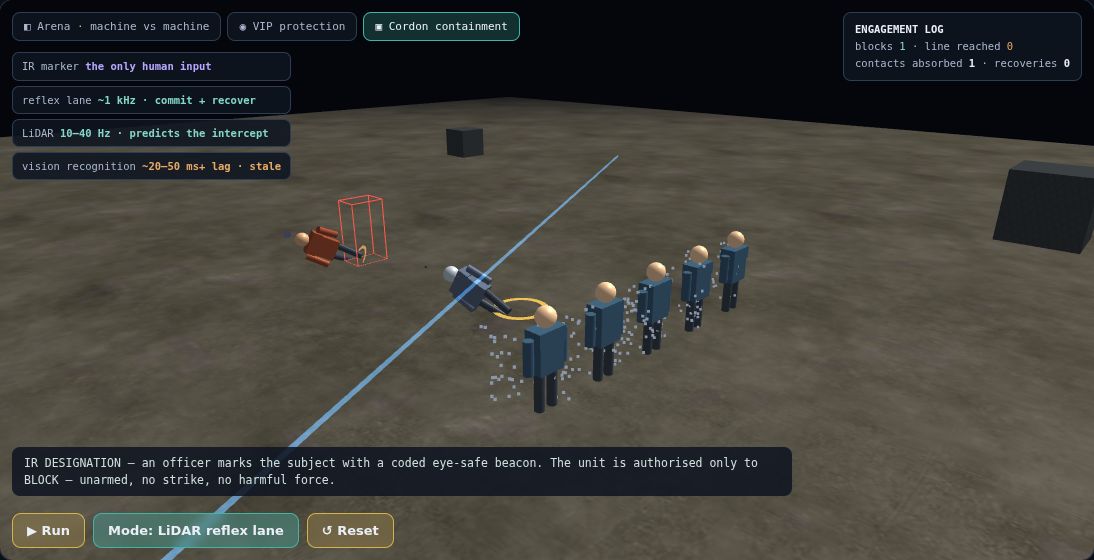
The Phase II robotics paper made runnable, in four scenarios. Watch a robot fighting league and you see the same defect: a unit commits to a strike at an opponent that has already moved, because its recognition loop is tens of milliseconds behind. Arena shows that failure and its fix — LiDAR with between-frame prediction commits to the intercept point, where the target will be. Fragile package (a storeroom of working, non-hostile machines), VIP protection and cordon containment turn the same competence protective: a humanoid guardian holds a standoff around a designated person, or blocks a designated subject from reaching a line of officers and public. Throughout, the infrared marker is the only human input — it designates who is protected and who is not — and the response is bounded, human-authorised and non-kinetic: the machine interposes, blocks and absorbs. It is unarmed, never strikes a person, and applies no harmful force; its advantage is that it can take an impact instead of a person having to, then run pre-load → detect → absorb → reacquire and stand up again. Collisions resolve with real separation and momentum exchange. Cadences are engineering targets, not measurements (§3.3); the Guardian pattern is placed after regulation, not before it (§6.3).

Open the demo New tab Live · WebGL
Interactive · illustrativeDeposited model v1.2.0 Interactive

ARGUS-PD tradespace explorer

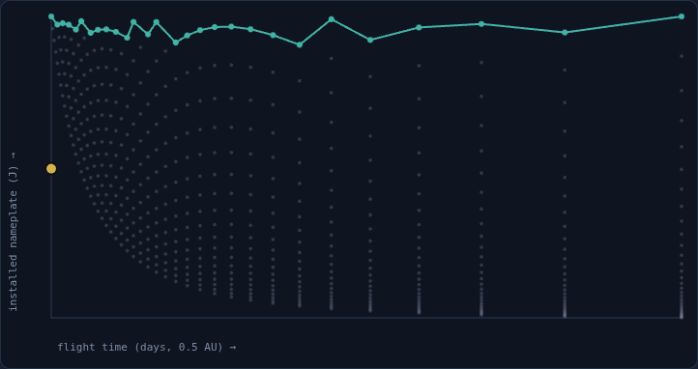
The tradespace explorer: a scatter of candidate configurations with the non-dominated frontier traced across the top
Conservation-law screen · live frontier · evidence gates

Move moving-mass and release-speed sliders; watch energy, momentum, installed nameplate, ideal field, flight time and the covariance miss-screen recompute against the deposited 28-point non-dominated frontier and the paper's evidence gates. Reproduces the deposited reference family exactly.

Interactive 3D · illustrativeDeposited model v1.2.0 Interactive

Geomagnetic orbit screen — 3D

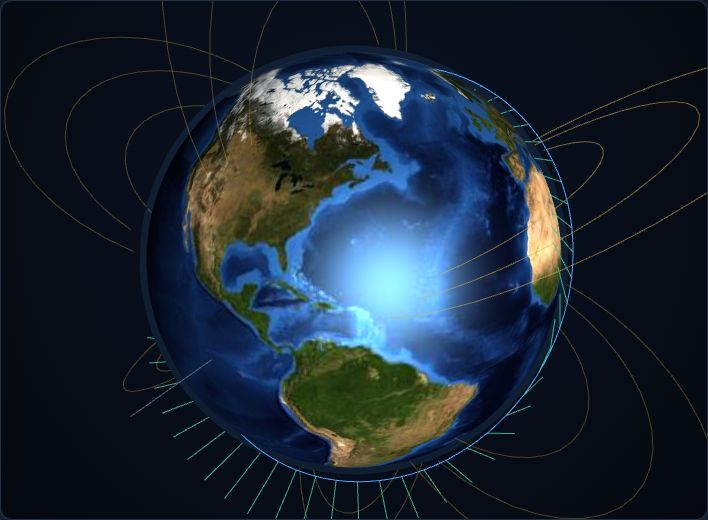
The geomagnetic orbit screen: a rotatable 3D globe with an orbit track and the per-orbit control-authority read-out
IGRF-14 degree-1 field · orbit authority · rotatable globe

Rotate the Earth; set altitude, inclination and torque axis; the IGRF-14 degree-1 field and per-orbit control authority recompute live. The in-browser port reproduces the deposited Python screen to 10⁻¹³ across all 27 reference cases — nine orbits × three torque axes — verified on load.

Interactive 3D · illustrativeDeposited budget v1.2.0 Interactive

Launch architecture & projectile — 3D

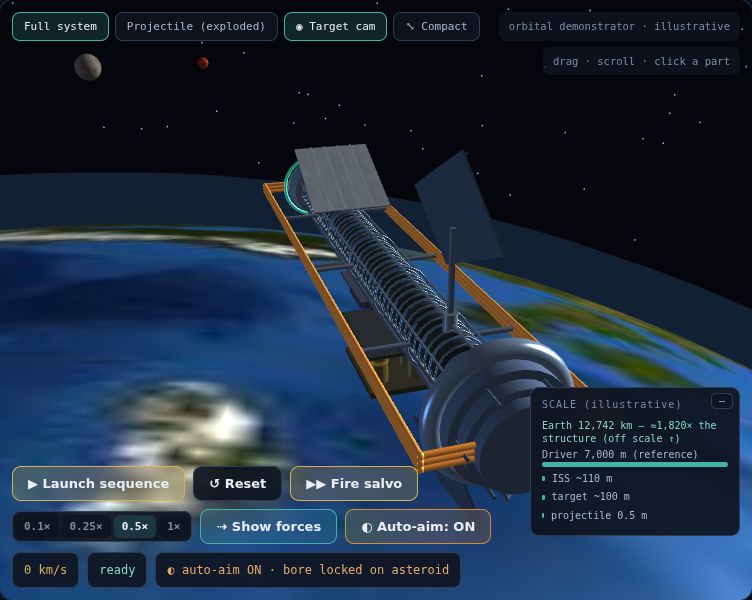
The launch architecture in orbit above Earth
Conceptual driver + exploded projectile · family & target selectors · force overlay · launch-to-impact

A rotatable 3D view of the ARGUS-PD/POD-7K architecture: the seven-kilometre driver — 1,000 × 7 m cells at 150 MJ each — and an exploded projectile whose every component is clickable and labelled with its deposited mass allocation (core 0.150 kg, coupling collar 0.090 kg … total 0.300 kg). Pick a projectile family member and a demonstration target, toggle the force overlay, and run the launch to watch the cell wave sweep the shot down the bore and coast to impact — with a Δv read-out under Paper I §8: delivered energy is calculable, useful deflection is not. Schematic and not to scale; no buildable design.

Interactive · illustrativePaper relation Interactive

Slew-time / dipole tradeoff

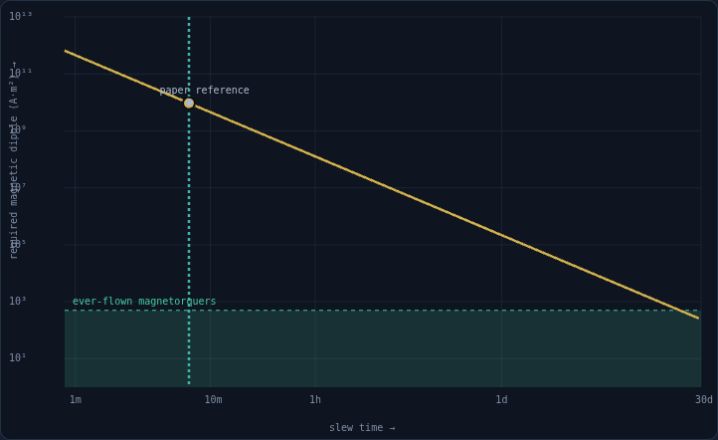
The slew tradeoff: a log-log chart of required magnetic dipole against slew time, with the ever-flown magnetorquer band marked
Why magnetic control is stabilising but slow — the geomagnetic paper's headline

A log–log chart of the dipole a magnetic actuator needs to slew a large platform against the time it takes. Set the platform and watch the required dipole for a fast turn shoot past anything ever flown, while a realistic dipole leaves you slewing for hours to days. Reproduces the paper's 1-km / 10⁵-kg, ~7-minute, ~10¹⁰ A·m² reference.

Interactive · illustrativeDeposited model v1.2.0 Interactive

Evidence-gate sequence

The evidence-gate sequence: the two conservation screens resolving pass or fail above the eight open development gates
Falsification built in: a shot survives to the first gate it fails

Papers I–III separate what a configuration passes now from what remains to be tested. Choose a shot and see the two deposited conservation screens (kinetic energy ≤ 150 GJ, ideal field ≤ 16.5 T) resolve pass/fail with the other quantities as read-outs — then the eight open development gates P1–P8 (matched materials, collar, cell, pulse-store, subscale assembly, dust/gas exposure, trajectory environment, impact) that still require evidence. The 1,000 km/s reference stands unless a lower gate shows no scalable path: feasibility with an honest to-do list, not a false verdict.

Open the gates New tab Live · offline
Phase I

Preprints — applied systems & engineering

1 paper · submitted; pending peer review
Phase I · PreprintSubmitted; pending peer review

Solar Generation and High-Density Energy Storage for Large Self-Powered Orbital Platforms

Orbital power engineering — generation, storage & thermal

A first-order, physics-anchored study of a large orbital platform powered entirely by sunlight, treating generation, storage, load-levelling and thermal rejection as one coupled mass budget. Using the AM0 solar constant and current flight-qualified multijunction-cell efficiencies, it derives a defensible end-of-life areal power density (~250 W/m²), the eclipse-fraction and beta-angle duty cycle, and a rigorous flywheel-versus-SMES-versus-supercapacitor/lithium-ion storage comparison that motivates a hybrid bulk-plus-buffer architecture. Every physical constant is cited to a primary source and all system-level figures are explicitly labelled illustrative calculations; the analysis is confined to general large-platform power engineering and contains no weapon, launcher, or projectile content.

Read paper .html · Web page
Phase II

Theory & methodology

3 papers · submitted; pending peer review
Phase II · Systems / theorySubmitted; pending peer review

A Software-First Spatial-Intelligence Layer for Contact-Capable Robots

Perception, dynamic tracking, impact recovery, governance-by-design

A systems-level architecture for a software-first spatial-intelligence layer, built from four coupled components: a sensor-fusion runtime that separates a deterministic high-rate reflex lane from slower spatial and advisory-semantic lanes; a perception stack combining LiDAR-inertial odometry, a dynamic world model and multi-object tracking; a contact-prediction and impact-recovery primitive; and a cross-domain platform-adapter architecture. It gives particular weight to governance-by-design — meaningful human authority, immutable auditability, functional-safety conformance, and export/dual-use screening built into the control layer. The contribution is architectural and integrative, not empirical; no measured benchmark is claimed, and physical response is treated as human-authorised and non-kinetic throughout.

Read paper .html · Web page
Phase II · TheorySubmitted; pending peer review · law & policy

Orbital Denial and the Limits of the Outer Space Treaty: The Contested Legal Status of Kinetic and Conventional Space Systems

Public international law & policy — no engineering detail

Argues that Article IV of the 1967 Outer Space Treaty is an artefact of a Cold-War bargain that prohibits weapons of mass destruction in orbit but says nothing about conventional, kinetic or dual-use systems, leaving “orbital denial” legally contested rather than clearly prohibited. Through an interpretive analysis of the text and travaux, a mapping of where kinetic and ASAT systems fall in law, and a survey of the PAROS/PPWT deadlock and the turn toward “responsible behaviours,” it contends the gap cannot be closed by a new multilateral treaty. It closes by extending the author's Magnitsky model: targeted, nationally-anchored measures that harden emergent responsible-behaviour norms by attaching domestic consequences that cascade through the commercial space economy. It contains no engineering or capability detail — the categories used are terms of legal art.

Read paper .html · Web page
Phase II · TheorySubmitted; pending peer review

Geomagnetic Attitude Control and Slew Dynamics of Very Large Flexible Space Structures

Propellantless magnetorquer control at kilometre scale

Develops the physics of magnetic attitude control for multi-kilometre space structures from first principles: the τ = m × B torque law and its instantaneous rank-two under-actuation, the geomagnetic environment, the rest-to-rest slew problem under bounded torque, and the coupling to a flexible truss's low-frequency bending modes. A clearly-labelled illustrative calculation for a 1-km, 10⁵-kg reference platform shows that a 90° slew in ~7 minutes would demand a magnetic dipole of order 10¹⁰ A·m² — seven to eight orders of magnitude beyond any flown magnetorquer — whereas achievable dipoles yield slew times of hours to days. The central conclusion is that magnetic-only control is attitude-stabilising but slow, and that its low bandwidth is in fact a virtue for a gravity-gradient-dominated flexible structure. All numerical examples are labelled illustrative; the paper is platform-agnostic and contains no weapon, launcher, or targeting content.

Read paper .html · Web page
Drafts

Working drafts — space systems & space law

8 drafts + annex · package v1.2.0 · not yet submitted

Eight drafts posted for reading (July 2026), plus the consolidated reproducibility annex. Papers I–III, the legal article and the geomagnetic article are now at manuscript v1.1.0 — their final revised editions — and the launcher-science study, the planetary-defence authorisation paper and the programme capstone are new. Two revise work already on this page: the geomagnetic paper corrects four overclaims in the Phase II web version, and Paper II supersedes the earlier 49 km analyses. All are drawn from publication package v1.2.0, whose 228-file checksum manifest verifies clean; DOIs are not yet minted.

Supplementary materialsReproducibility annex v1.0.0 · superseded by package v1.2.0

Supplementary Materials & Reproducibility Annex (Papers I–III + geomagnetic)

Model, parameter tables, deposited data, code listings, tests, SHA-256 manifest

Answers the reader's “where does that number come from?” in one place: study constants and mass budget, every governing relation as implemented, the deposited data tables (reference family, 28-point frontier, orbit screen), the full code listings, the passing unit tests, and a SHA-256 manifest. Note: this annex is the v1.0.0 edition and documents the original seven-test suite; the current package carries 21 unit tests and adds the programme cost model. Retained for reference until the annex is rebuilt.

Read the annex (PDF) .pdf · 15 pages
Working draft · v1.1.0Not yet submitted · revision in progress

Conventional Counterspace Conduct and the Outer Space Treaty

Article VI supervision, responsible behaviour and nationally anchored market conditionality

Article IV of the 1967 Outer Space Treaty does not comprehensively prohibit conventional weapons, anti-satellite capabilities or all military activity in outer space — but that proposition does not create a legal vacuum. This draft develops Article VI supervision, responsible-behaviour norms and nationally anchored market conditionality as the operative framework for conduct the treaty does not specifically prohibit. Companion to the published “Orbital Denial” paper.

Read the draft (PDF) .pdf · 16 pages
Working draft · v0.2.0Circulated for comment · not yet submitted

Authorising Planetary Defence

Article IV characterisation, Article VI supervision and independent oversight for high-energy civil planetary-defence research systems

The companion legal paper that ARGUS-PD/POD-7K Paper II defers to. Characterises the hypothetical system under Article IV of the Outer Space Treaty (conventional-kinetic research outside the Article IV(1) WMD prohibition; Article IV(2) celestial-body limits regardless of civil labelling), analyses registration and liability for objects launched from an orbiting platform, engages Koplow's counter-position on debris-creating destructive testing, and proposes an independent-oversight model in which authorisation advances only through the technical series' own evidence gates — offered as policy consistent with existing law, not as existing law.

Read the draft (PDF) .pdf · 21 pages
Working draft · v1.1.0Not yet submitted · revision in progress

Feasibility Bounds for Geomagnetic Attitude Control of Very Large Flexible Space Structures

An IGRF-14 orbit screen, slew lower bounds and control-structure qualifications — revised edition

Derives feasibility bounds for magnetic attitude actuation of a very large flexible structure in low Earth orbit. This edition corrects four overclaims in the earlier version published on this site — beginning with the recognition that magnetorquers are not the only propellantless source of external torque. Supersedes the Phase II web version above.

Read the draft (PDF) .pdf · 12 pages
Working draft · v1.1.0Not yet submitted · revision in progress

ARGUS-PD/POD-7K Paper I — Parametric Design-Space Analysis of a Modular Projectile Family and Electromagnetic Launch Interface

Methodological, not demonstrative — the projectile-side design space

Examines the projectile-side design space of a hypothetical seven-kilometre electromagnetic planetary-defence research system, coupling moving mass, release speed, kinetic energy and momentum across a modular projectile family and its launch interface. The reference point is a 0.300 kg complete moving assembly at 1,000 km s⁻¹ — a definition that resolves a contradiction in earlier drafts, which assigned 0.300 kg to the core alone while treating the collar and release package as uncounted mass.

Read the draft (PDF) .pdf · 22 pages
Working draft · v1.1.0Not yet submitted · revision in progress

ARGUS-PD/POD-7K Paper II — Integrated Architecture and Feasibility Bounds at a Fixed Seven-Kilometre Active Length

Launcher, pulse energy, structure, thermal, control, deployment and civil governance — integrated

Integrates the launcher, pulse-energy, structural, thermal, control, deployment and civil-governance consequences of fixing the hypothetical research system at exactly 7,000 m active length. Supersedes the earlier 49 km analyses.

Read the draft (PDF) .pdf · 19 pages
Working draft · v1.1.0Not yet submitted · revision in progress

ARGUS-PD/POD-7K Paper III — Coupled Feasibility Boundaries, Uncertainty Propagation and Falsification Criteria

Closes the sequential core: a reproducible parametric closure with explicit falsification criteria

Replaces the earlier narrative series synthesis with a reproducible parametric closure of the ARGUS-PD/POD-7K research architecture — asking under what combinations of modelling error its feasibility claims would fail, and stating the criteria on which the architecture should be rejected.

Read the draft (PDF) .pdf · 17 pages
Working draft · v1.0.0New — standalone study · not yet submitted

ARGUS-PD/POD-7K Launcher Science and Application Envelope

Distributed pulse-module architecture, counter-impulse closure, projectile-family physics and space-only research utility

Asks what a seven-kilometre launcher and its projectile family would be scientifically useful for if the mechanism could be made to work — with asteroid deflection retained as one worked application rather than the organising purpose. Separates two control spaces: the 150 GJ iso-energy family (0.300 kg at 1,000 km s⁻¹ through to 30 kg at 100 km s⁻¹, where direct momentum rises tenfold as speed falls) and a variable-energy sequence for the 0.300 kg article spanning 0.15 to 150 GJ. Treats the rear-valve proposal honestly as momentum export: a 3 MN s shot moves a 2,000 t platform by 1.5 m s⁻¹, and cancelling it would need 666.7 kg expelled at 4.5 km s⁻¹ without removing structural reaction. Also screens interplanetary dust as an impactor in the projectile frame — at 1,000 km s⁻¹ a 1 µg grain carries 500 J. Concludes the strongest independent cases are hypervelocity impact and shock research, not intervention. Orbital-debris use is explicitly rejected because fragmentation can worsen the hazard.

Read the draft (PDF) .pdf · 30 pages
Working draft · v1.0.0New — programme capstone · not yet submitted

ARGUS-PD/POD-7K Programme Capstone — Operational Plausibility, Build Sequence, Cost Exposure, Governed Control and Strategic Space Advantage

What a consortium would have to build, in what order, at what cost, under which control regime

Papers I–III establish a controlled theoretical programme; they do not establish that anything can be built, afforded, deployed or authorised. This capstone addresses that gap without converting a research concept into an operational plan. Four findings. Eight years is a decision horizon, not an operational date — a first supervised civil capability sits in a conditional 12–16-year window. Batteries buffer but cannot pulse: the 514.286 GJ nameplate is about 36.5 Tesla Megapacks by stored energy, yet their 35.7 MW output against a 30.6 TW admitted-power screen leaves a power-rate gap of ~8.6×10⁵; Sandia's Z facility is ~2.3×10⁴ times smaller by stored energy. A line-by-line cost re-audit gives an $18.1 bn direct most-likely sum, and a risk-loaded P50 of $24.3 bn and P80 of $27.1 bn in constant June-2026 dollars — research-planning assumptions, not quotations. And strategic advantage is argued as credible while unilateral supremacy is explicitly rejected.

Read the draft (PDF) .pdf · 29 pages