
Meridian — Regulatory-Impact Market Tracker
A provenance-first intelligence platform that answers the board's real question — which regulatory changes actually hit us, and does it matter — with every figure carrying its own source and as-of date.
01The problem
Horizon-scanning feeds tell a legal or compliance team that a rule changed. They almost never answer the question the board actually asks: does this touch our business, and how hard? Mapping new rules, amendments and sanctions moves onto a specific issuer's activities is done by hand, late, and without an audit trail — and commercial data vendors make it worse by blending disclosed facts, estimates and model output into single numbers with no provenance. For a regulated firm that is a genuine hazard: a figure you cannot trace to a source is a figure you cannot put in front of a regulator, an auditor or a court. Regulatory-change management is a supervisory expectation; guesswork dressed as intelligence is not.
02What I built
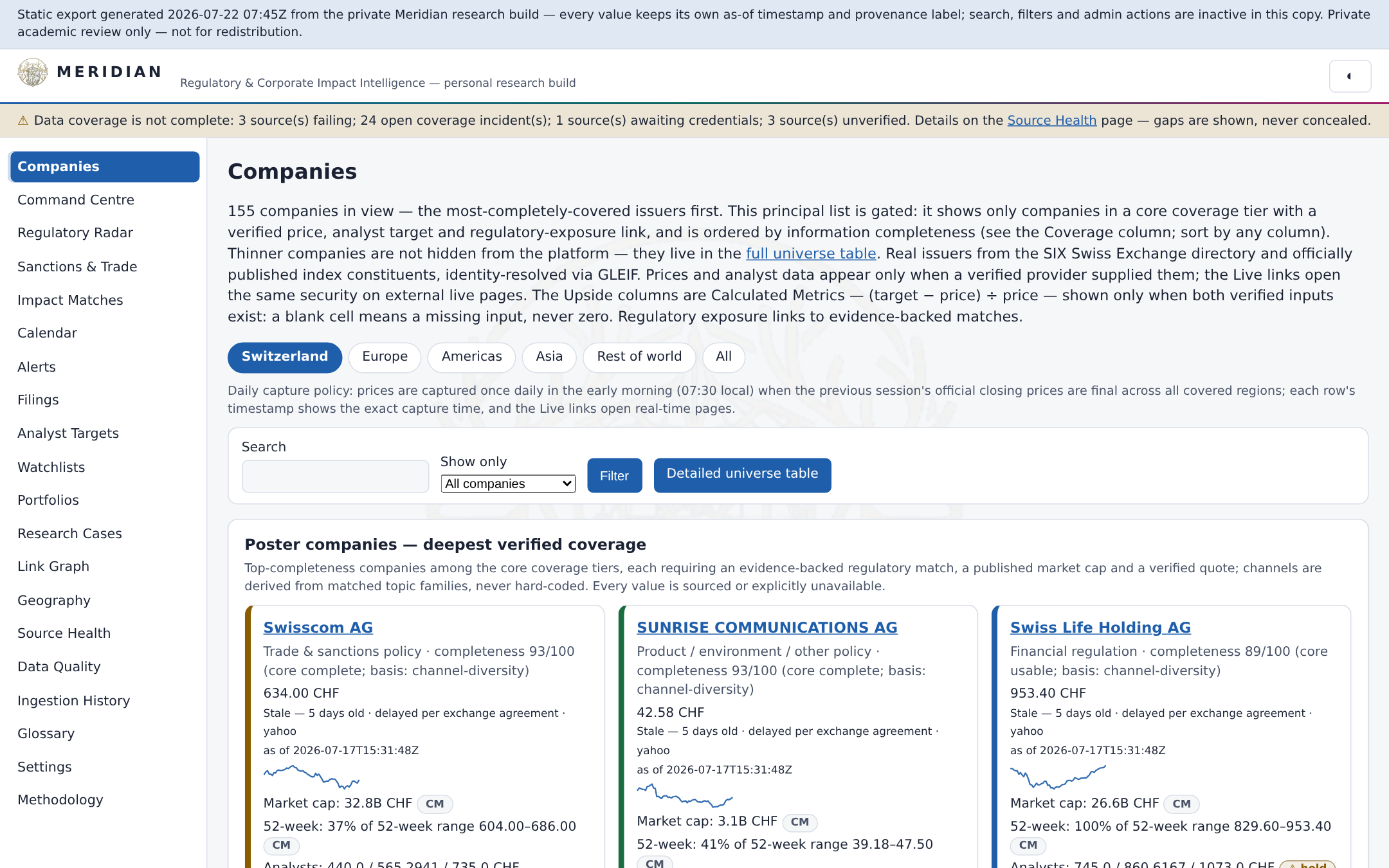
Meridian is a Python + SQLite platform with scheduled ingestion under a fixed API budget, tracking real issuers drawn from the SIX Swiss Exchange directory and officially published index constituents, against regulatory and sanctions sources including EUR-Lex/CELLAR, Fedlex, FINMA, SECO, legislation.gov.uk, the EU consolidated financial-sanctions list, UK OFSI, US OFAC and SEC EDGAR, and the UN Security Council consolidated list.
- Provenance per value: every sourced row stores its source key, canonical URL, retrieval and publication timestamps, an immutable raw artifact, a SHA-256 content hash and the parser version.
- Six value classes — Source Fact, Company Disclosure, Official Regulatory Fact, Calculated Metric, Evidence-Based Inference, Unverified — so an inference is never presented as a disclosed fact.
- Deterministic identity resolution (ISIN → LEI, Swiss UID, CIK), with every acceptance logged and unresolved securities left visibly unresolved.
- Impact scoring as a weighted average of named factors, stored per assessment; five linkage layers (direct legal applicability through contradictory evidence), all review-gated.
- A 14-state source-coverage model with incidents, alerts and a Source Health page — gaps are shown, never concealed.
03The rules of evidence, applied to data
Meridian is the rules of evidence applied to data engineering. The governing judgement is that an intelligence platform for regulated use must refuse to know things it does not know: exposure and materiality stay marked “insufficient evidence” until disclosed figures — segment or geographic revenue — are actually ingested; they are never estimated. Semantic similarity alone never establishes a material relationship between a rule and a company; it only nominates candidates for review. Composite scores are labelled for what they are: a way of ordering a queue, not a view on what a security will do. And because every value keeps its capture timestamp, hash and source, any answer the platform gives can be taken apart claim by claim — the same way a lawyer builds a submission: assertion, source, date, weight. That discipline is the product; the charts are decoration.
04Why it matters to a regulated employer
Regulatory-change management, sanctions monitoring and exposure assessment are standing obligations for banks, commodity houses and listed issuers — and they are exactly the process Meridian operationalises: what changed, who it touches, how material, and on what evidence. For a counsel or advisory role, the platform demonstrates the judgement those functions run on — knowing what counts as a fact, when the honest answer is “we don't know yet”, and how to keep an assessment challengeable rather than merely confident. It also shows I can specify and govern the data layer beneath a compliance function, not just consume its reports.