
Helm — Automated Project Manager
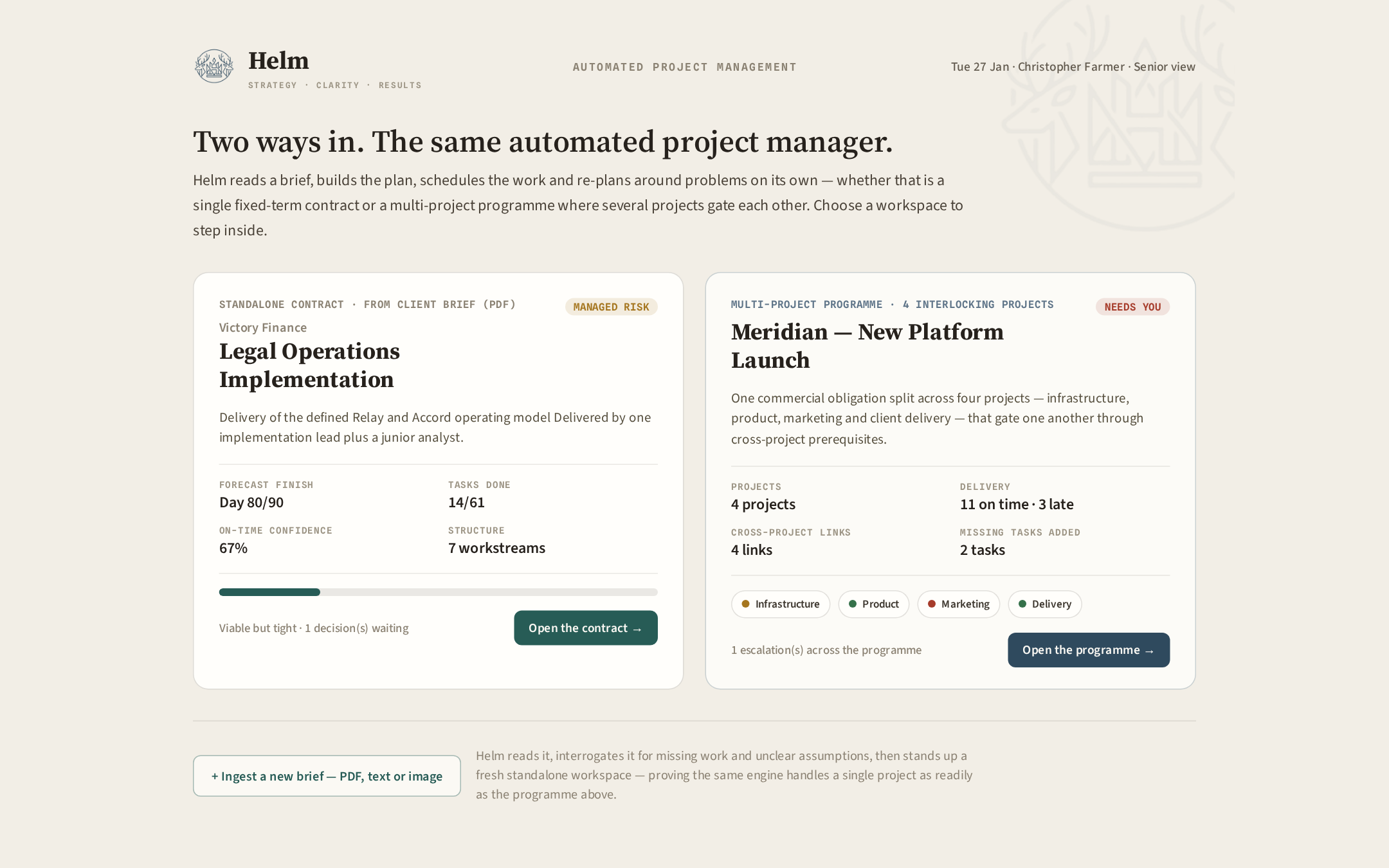
A scheduling engine that turns a written brief into a live programme — and, when something slips, re-plans every view while keeping the record of why.
01The problem
Regulatory programmes rarely fail for lack of intent — they fail on sequencing and capacity. A remediation plan, a licence application, a GDPR or AI-Act readiness rollout is a network of dependent obligations converging on dates that are often statutory, and therefore not negotiable. Yet in most organisations that network lives in slide decks: static, instantly stale, blind to the downstream effect of a single slip. When a milestone moves and a funder, auditor or supervisor asks why, and what you did about it, the answer is usually reconstructed after the fact rather than retrieved from a record. I ran an eight-site organisation's compliance delivery for years; this is the tool I wanted — plans that stay live, and change that stays evidenced.
02What I built
Helm's pipeline runs brief-parser → dependency graph → capacity & critical-path scheduler → portfolio “windrose”: you write the brief in prose, and Helm turns it into a costed, sequenced, staffed schedule.
- Tasks are fully editable — split, reorder, re-scope — with role-based views and multi-project rollups above them.
- Log a delay or a blocker and every view re-plans around it: the critical path, capacity loading and escalations are recomputed by the engine, not redrawn by hand.
- The scheduling and graph logic is a self-contained JavaScript engine, and what you open here is the app itself rather than a recording of it — every schedule is computed on the spot, in the browser, with nothing fetched from a server.
- The same scheduling approach carries into my Phase II feasibility-methodology preprint, where critical-path analysis under deep uncertainty is applied to very large programmes via an event-sourced Monte-Carlo engine.
03Three judgements the scheduler encodes
Helm rests on three judgements. The first is that a deadline with legal force is a constraint, not an aspiration — so statutory and contractual dates anchor the graph, and legal risk is read directly off the critical path that leads to them: if the path breaches the date, that is a compliance fact, visible early enough to act on. The second is capacity honesty: a plan that quietly assumes more delivery capacity than exists misrepresents the position to everyone who relies on it — boards, funders, regulators — so the scheduler plans within declared capacity and surfaces the overload instead of absorbing it. The third is that change control is the audit trail: diligence has to be provable, which means the re-plan, its trigger and its escalation are recorded as events rather than overwritten — the difference between telling a supervisor what happened and showing them.
04Why it matters to a regulated employer
Counsel and advisory work is, in large part, regulatory delivery: DPIA and records rollouts, sanctions-programme remediation, s.166-style review responses, AI-Act readiness — obligation networks with owners, dependencies and dates. Helm demonstrates the operating judgement behind that work: decomposing an obligation into an executable plan, staffing it against real capacity, protecting the statutory dates, and evidencing every change when scrutiny arrives. It reflects how I actually ran multi-site compliance delivery — and shows I can bring that governance to a programme as a working system, not a slide.