Nobody Else Is Coming
An operator’s playbook for crisis, compliance and capital in organisations too small to have a department for it
Christopher I. V. Farmer · First edition, October 2026 · practitioner handbook, 75 pages · doi:10.5281/zenodo.23462160
What it is
A playbook for the person who gets the phone call. Not the one who says “we have a governance problem” — nobody says that. The one who says “could you have a look at something.” The something turns out to be a charity six weeks from missing payroll, or a funding audit that will find what nobody has looked for, or a founder about to sell more than half of a twenty-year asset to fix a problem that lasts a year or two.
In a large organisation these are three different departments. In the organisations this book is about — charities, community interest companies, training providers, owner-managed businesses, single-asset projects — they are one person, and for a while that person is you. The book is about how to take charge of a problem nobody owns, carry it across law, money, people and operations without dropping any of them, and leave behind something that still works after you have gone.
It is written from the operator’s chair, not the adviser’s. An adviser produces a view; an operator produces a decision, a control and a record, and is still in the room when the decision turns out to be wrong.
What is in it
Part I — The method
- The call. The five questions, the mandate letter, the operator’s own position — liability, insurance, getting paid — and saying no.
- The first seventy-two hours. Cash, law, people, reputation, in that order; the week the controls are weakest; the weekly payment schedule.
- Diagnosis. What kind of situation this is, reading the whole organisation, the decisive constraint, the three risks and the early wins.
- Governance that works in practice. Cadence, the anxious board, delegated authority with an expiry date, conflicts, and founders, families and volunteer boards.
- Controls that survive an audit. What a control is, the design rules, evidence packs, retention and continuity.
- People. The team you inherit, help in forty-eight hours, resistance, the outsider’s politics, and cutting jobs humanely as well as lawfully.
- Regulators, funders and money. No surprises, and what to do when the regulator is not a partner.
- Nobody else is coming. The operator’s own judgement, network and limits.
- Embedding, and leaving.
Part II — Three domains, each with a worked case
- Crisis and cash. The creditor duty after Sequana, wrongful trading, the moratorium, restricted funds and serious incidents; the thirteen-week cash flow, closing the gap, the decision tree, creditors by class, pensions and exits. Case: a charity that lost its forecast.
- Compliance architecture. Culture, the regulatory map, the obligations pipeline, AI, funding assurance, data protection after the Data (Use and Access) Act 2025, safeguarding and speak-up. Case: a provider with four weeks to prove what it delivered.
- Capital and structure. Venture or asset, the three numbers behind a technical claim, the project vehicle and the lease, the risk table, debt sizing, a financing menu for a small project, and integrity as a financing condition, with the Philippines as the worked jurisdiction. Case: a founder who nearly sold the plant to build it.
Appendices
Checklists built to be read aloud at the moment they are needed; eighteen templates; dated regulatory maps for a charity in difficulty, a funded training provider and a small solar project; a reading list that says what each of the standard playbooks covers better than this one; and a glossary.
The worked cases are illustrations, not records. The organisations, figures and people in them are invented, and no case is a portrait of any organisation, named or unnamed — including those the author has worked for, governed or advised. Each shows the method applied, with a wrong turn, a dilemma the method did not settle and what it cost. The law, the regulators, the guidance and the arithmetic in them are real, and are cited.
The three worked cases, as case studies
Each chapter of Part II ends with a worked case. The three are set out here as six-page case studies: the call, the diagnosis, the thirteen weeks or the four, the wrong turn, the dilemma the method did not settle, and the shape of the outcome, with the figures drawn as charts. They are illustrations, not records: the organisations, figures and people are invented, and each case study links to the chapter it comes from.
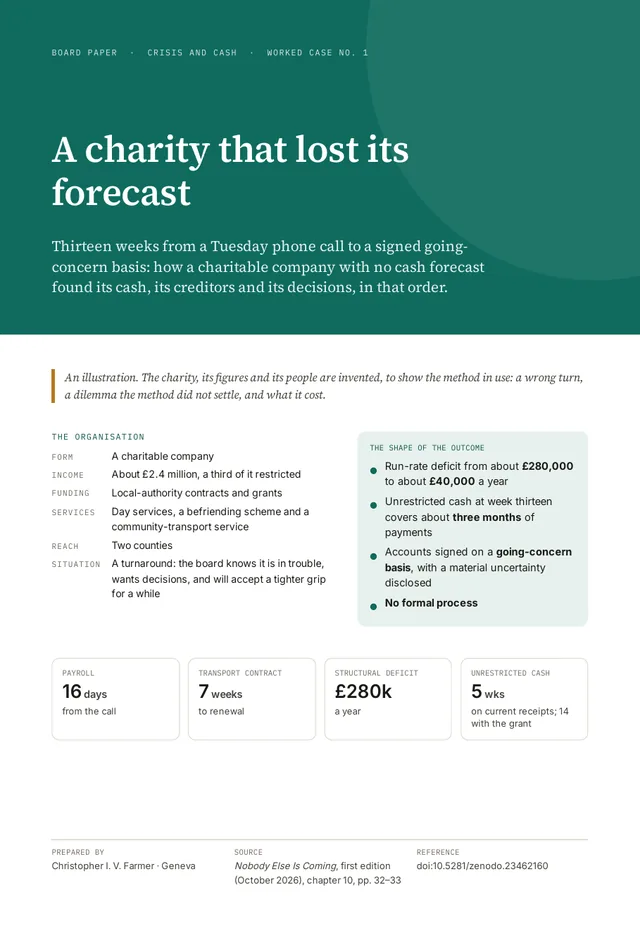
Worked case · chapter 10, crisis and cash · 6 pages
A charity that lost its forecast
A charitable company with no cash forecast, a resigning finance manager and payroll in sixteen days: thirteen weeks to a signed going-concern basis.
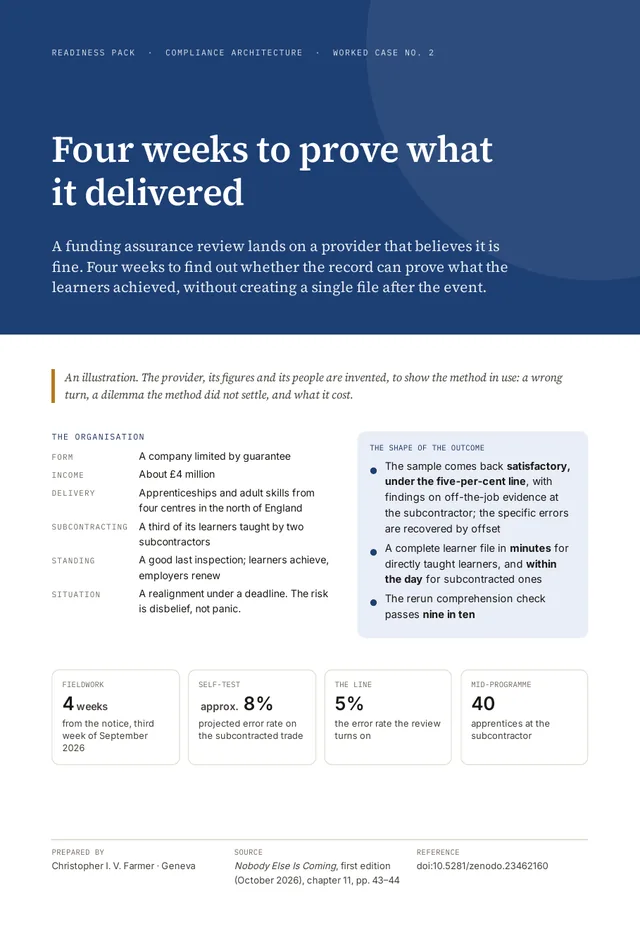
Worked case · chapter 11, compliance architecture · 6 pages
Four weeks to prove what it delivered
A training provider given four weeks’ notice of a funding assurance review, with a third of its learners taught by subcontractors and no one owning their evidence.
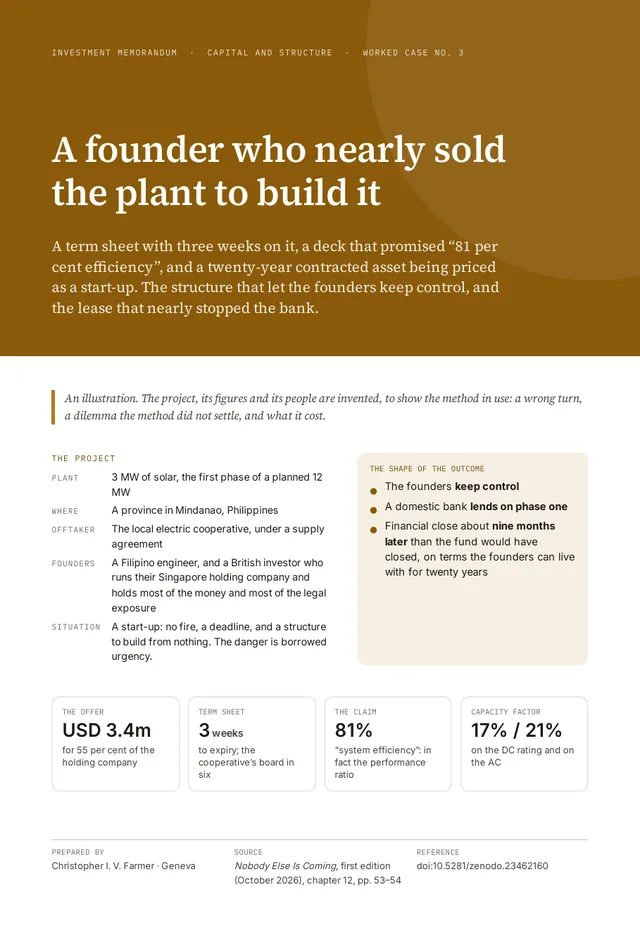
Worked case · chapter 12, capital and structure · 6 pages
A founder who nearly sold the plant to build it
A 3 MW solar project in Mindanao, a venture fund offering USD 3.4 million for 55 per cent, and the question that decides everything downstream: venture or asset?
What the deliverables look like
Three example deliverables of the kind the method produces, published beside the book. They are not the book’s worked cases: the first is a simulation, the second represents controls the author ran, with confidential details redacted, and the third is a worked example with client and place names removed. Each PDF is an image of the printed page with no text layer, so the description beside it serves as its text.
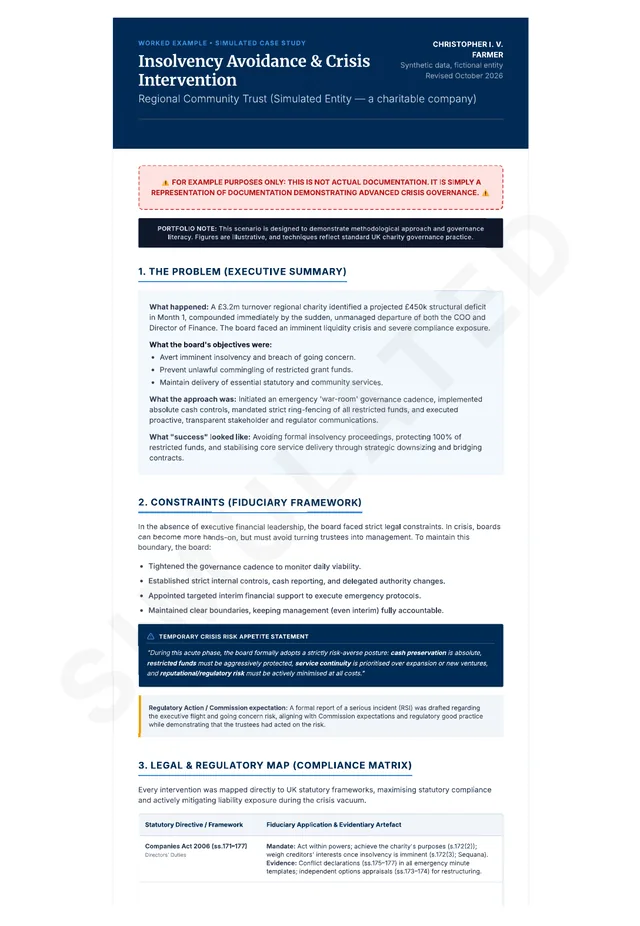
Simulated worked example · 7 pages
Insolvency Avoidance and Crisis Intervention
A simulated worked example of an insolvency-avoidance and crisis-intervention plan for a charity facing a £450k structural deficit after the sudden departure of two senior executives. The organisation and every figure in it are invented. Over seven pages it maps the trustees’ legal duties and sets out the emergency governance, the internal controls, a thirteen-week cash plan, the board’s options appraisal and the lessons drawn afterwards.
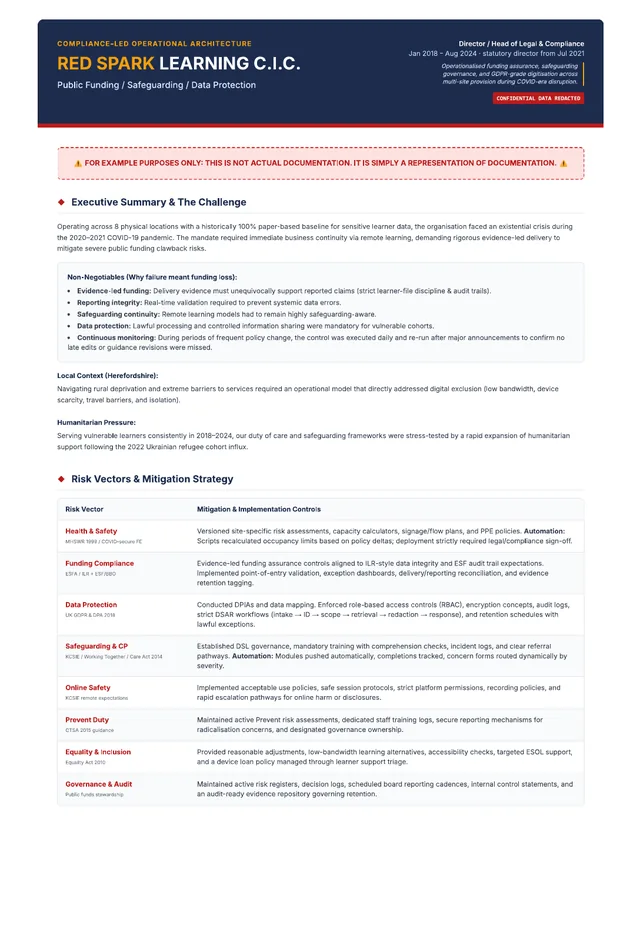
Real controls, redacted · 4 pages
Red Spark Learning C.I.C. — Operational Scaling: Portfolio Brief
A representation of the documentation of the compliance and operating controls the author ran as Director and Head of Legal & Compliance at Red Spark Learning C.I.C., 2018–2024 (statutory director from July 2021): risk controls for eight sites moving to remote learning, funding assurance, safeguarding, data protection, and the evidence and outcomes each control produced. It is not a simulation: the figures are real, and confidential details are redacted.
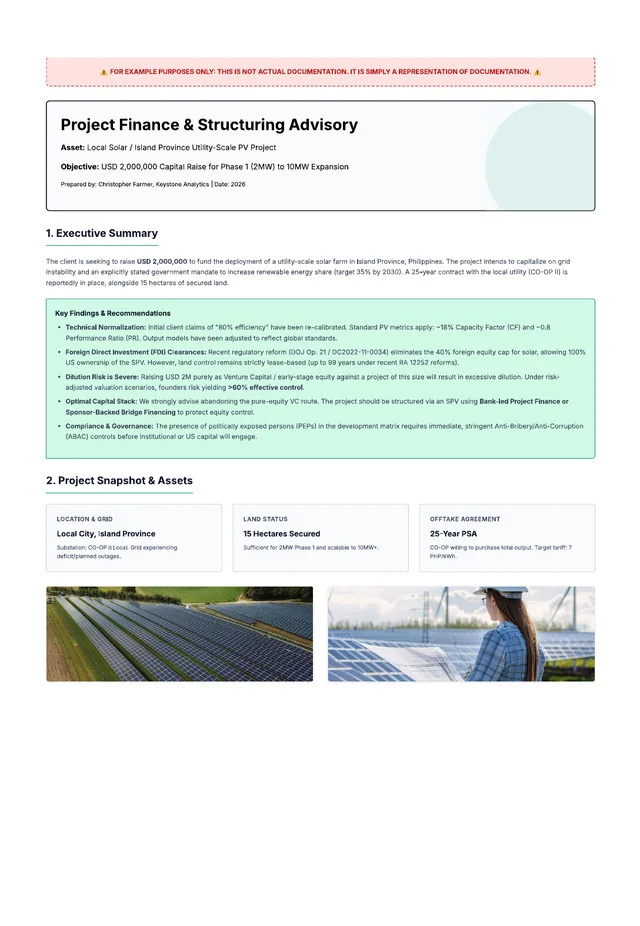
Worked example, names removed · 5 pages
Project Finance and Structuring Advisory: a utility-scale solar project
A project-finance and structuring advisory worked example for a utility-scale solar project in a Philippine island province, raising USD 2 million for a first phase; client and place names are removed. Over five pages it normalises the technical claims (capacity factor rather than “efficiency”) and sets out the financial baseline, the foreign-ownership and land-lease rules, the project vehicle and contract stack, financing routes other than venture capital, and the integrity checks lenders will expect.
Status
Independent practitioner handbook; grey literature. The law and guidance are stated as at 16 October 2026, with their instruments and dates, for England and Wales and, in Chapter 12, the Philippines. Nothing in it is legal, financial or investment advice. Licence: Creative Commons Attribution–NonCommercial 4.0 International (CC BY-NC 4.0): you may share and adapt it, templates included, for non-commercial purposes, with credit.
How to cite
Farmer, C. I. V. (2026). Nobody Else Is Coming: An Operator’s Playbook for Crisis, Compliance and Capital (first edition). Zenodo. https://doi.org/10.5281/zenodo.23462160
— Christopher I. V. Farmer · civfarmer@gmail.com